This post documents the first field recording trip to the farm that the SOIL+AiR creative future landscapes project will be based at for the next year. SOIL+AiR is a creative rural research residency aiming to explore the rural landscapes and communities of the Narromine Shire in Central West NSW, that, like many regional communities across the world, are grappling with many complex issues impacting their future.
Willydah is owned and operated by the Maynard family—Bruce, Roz, Liam, Ella and Hannah. Bruce is fourth generation on the 1500ha property, where over the past three decades he has converted it from conventional mixed farming to a functionally diversified landscape of complex grasslands, shrubs and trees supporting livestock and cereal crops for grain and grazing. He’s been able to increase productivity and margins at the same time as building ecological diversity. His kids are also now involved in the farm enterprises, bringing their interests and understanding to exploring new products and markets within the agroecology system set up by their father over the past 30 years.
In 2022, Bruce was recognised for his pioneering work on low-impact cropping, winning the National Landcare Award for his work on the No Kill Cropping System and other innovations. He said to Landcare Australia at the time: No Kill Cropping is a game changer for sustainable farming because it lets farmers change easily and quickly between a grazing enterprise and cropping enterprise in the one paddock. I really believe that farmers have the opportunity to work together to address some of the greatest pressures facing us globally such as climate change and species decline. I hope that my work will inspire others to begin their own sustainable farming journey and contribute to a greener future for Australian farming.
I’ve known Bruce since my days as a rural journalist and regional communications specialist in the 1990s and 2000s, when he was planting saltbush in different configurations as a way of putting shrubs back into a cleared landscape. Very few conventional Australian farms, mixed or grazing, include shrubs in their paddock mix. From the day I put this residency idea to Bruce in early 2023, he’s been an enthusiastic supporter of the project and its creative exploration processes, writing: It is worth supporting initiatives that create closer connections to the environment and ways to sustain the human and natural diversity of landscapes. …proposals that deepen the connections across our communities gain my highest recommendation.
Germinating an idea
…it occurred to me this was really about the ecological edges or boundaries impacting or influencing the farm and how it sits in the landscape and community.
We spent a year, almost to the week of my first field recording trip to the farm on 11 July, planning how SOIL+AiR might work. With a small grant, I did a scoping study in late 2023, including creating connections in the UK*, with the aim of piloting a 12-month residency project starting in July 2024.
The starting point of the residency was to get some baseline recordings of the farm from a site of Bruce’s choosing, gathering recordings and a range of data including temperature readings, recent rainfall data, and a species list. There were also lots of questions. I put together an audio recording and observation kit for Bruce and talked him through how he might choose to use it. After all, this is a co-led project. Being together on farm was also a chance to talk over ideas of how, why, and what this residency was going to dig into. As we drove around the farm looking at different areas, the vegetation types and functions—from handplanted shrub blocks to crown roads, it occurred to me this was really about the ecological edges or boundaries impacting or influencing the farm and how it sits in the landscape and community. Boundaries are important to the function of systems, so a lot of ideas were starting to bounce around the inside of Bruce’s ute.
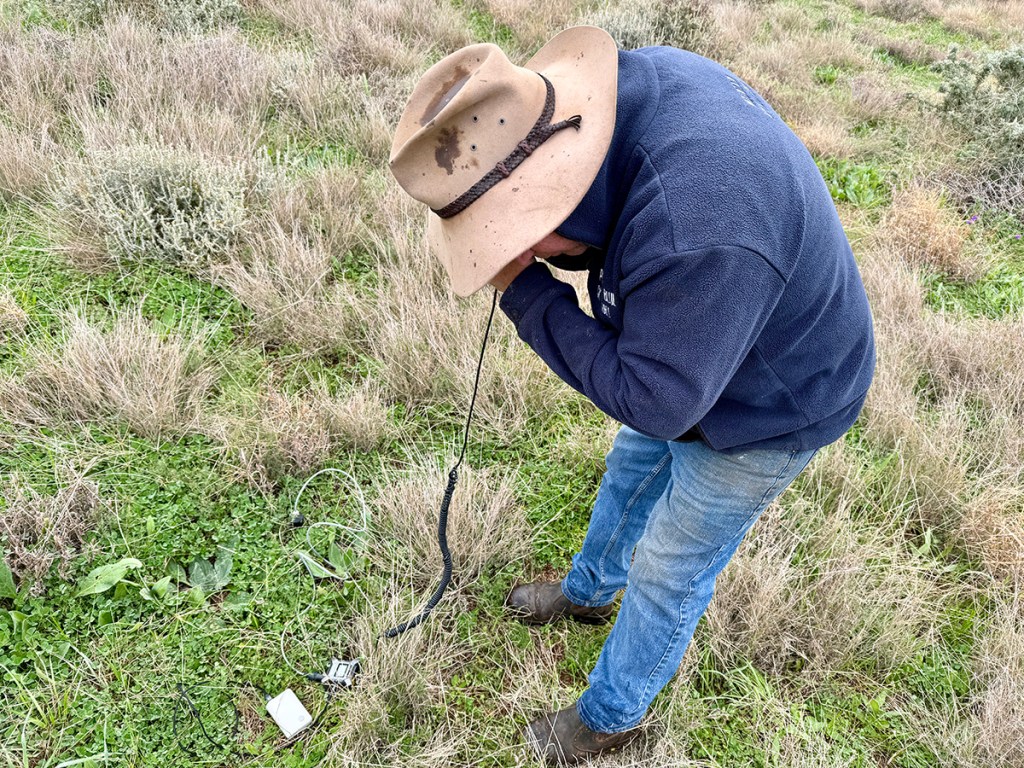
Bruce Maynard listening to his soils for the first time. Despite the cold soil temperature, there were subtle earthy sounds being picked up by the probe. They had a metallic tone to them, that I suspect was due to the length of the rod. This was the first time I’d been able to use a rod of this length. The microphone also picked up the nearby electric fence pulse—something to watch out for next time. 11 July 2024.
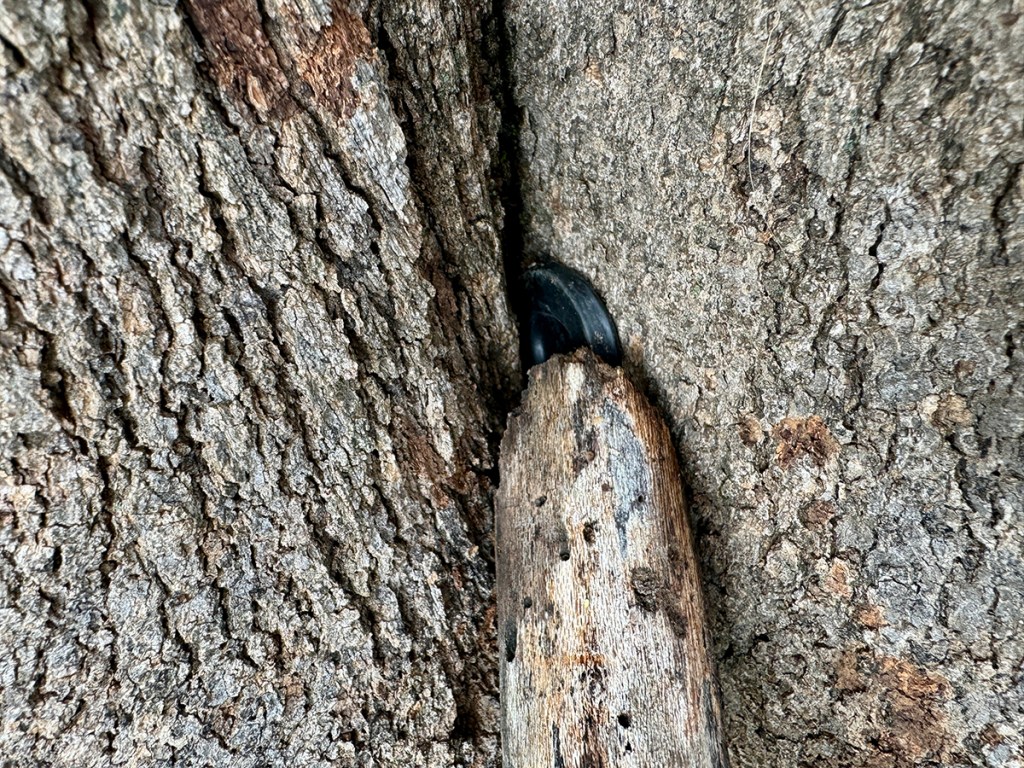
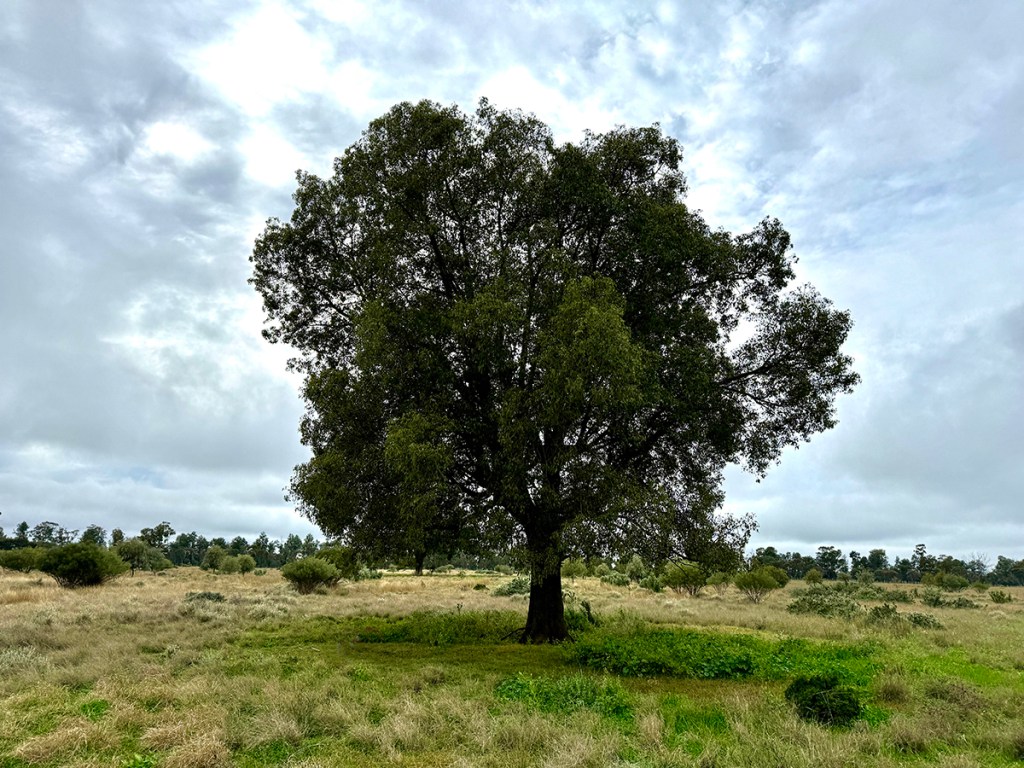
The chosen start date was a bitterly cold mid-winter’s day. The mid-morning air temperature was about 12 degrees, and the soil temperature reading was 10 degrees. There had been 20mm of rain only a couple of days before and the 37cm rod attached to the geofón used to record the soil went into the ground like a knife through butter. A pea-souper fog had hung over the region all morning and it remained overcast all day. A light breeze from the south was enough to cause the windshields on the mics to do their job. The Kurrajong tree I’d dropped my bags next to in the paddock rustled, clacked, creaked and groaned as it absorbed the wind. The contact mic I used to record the tree was wedged into a cleft in its thick base. With wind whistling past the contact mic as well as causing vibrations to shudder through the Kurrajong, two different types of sound were generated in the recording.
The LOM geofón with 37cm probe and the JrF contact mic in the cleft of the Kurrajong tree. 11 July 2024.
We also deployed an AudioMoth acoustic data logger programmed to record for six hours each day—sunrise, midday and sunset, for about five days. We’ll use the recordings and future ones to create a seasonal checklist of what birdlife and marsupial activity there is at this site. Some of the recordings might also make their way into a soundscape composition down the track. One of the things Bruce commented on while we were together is how he’s noticed the birdsong on farm diminishing over the years. Familiar with many of the region’s small bird species, I didn’t see or hear any in the paddock we were working in despite many larger, woodland species being active on the day.
Using princples of retention or relocation, livestock are an important to the ecology of Willydah. Livestock can be ‘self-herded’ across the farm landscape to eat weeds, tip prune plants to keep them healthy, putting organic matter back into the soil as they go, and churning soil crust to allow better water penetration. Bruce believes animals are an important part of regenerating not just the landscape, but the soils. However, there were no stock on the block we working on (other than kangaroos), which will again create a an acoustic baseline for when stock do come back into this paddock.
Digging into a new(ish) paradigm
Systems thinking and regenerative have become buzzwords. I believe ‘regenerative’, in particular, has started to lose its meaning.
The Willydah, Winter 2024 soundscape sample (below), released on World Listening Day, on 18 July, sets the scene for the year ahead but it also creates context for the project, the futures its exploring, and the activities Bruce and I will undertake. I’m sure we won’t always agree on what we’re seeing, hearing, or thinking, but the hope is we’ll learn from each other, and perhaps generate some curiosity from those who want to connect, learn, share, and contribute to making change in our rural communities. We’re also inviting the community to walk with us, share stories, and consider what actions we might each be able to take personal responsibility for.
Willydah, Winter 2024—a soundscape video sample with audio waveform, July 2024
My reading list for this residency is already growing and a great recent find at my local book shop was added to the pile— The Cultivated Landscape: An Exploration of Art and Agriculture (2008), by Craig Pearson and Judith Nasby. A few lines from Chapter 7 jumped out at me as I flicked through it: Where is agriculture heading? We suggest that its future lies in connectivity, and that connectivity may become the next paradigm, the next dominant way of thinking in many sectors of society…One desirable scenario could be described as “connected multiple futures”…Another key element for future connectivity will be the forging of common understandings between urban and rural people, and between societies in rich countries and those in poor ones.
Sixteen years have passed since those words were published. For all the ‘greenwashing’ and regenerative chatter in my social media feeds, I’m not seeing huge change in urban or rural communities. Systems thinking and regenerative have become buzzwords. I believe ‘regenerative’, in particular, has started to lose its meaning. Bruce and I have talked about this and we’ve agreed to be careful about how and when we use these terms in this project. Bruce prefers the term agroecology for what he’s doing on his farm.
In terms of using systems concepts for this project, it makes sense to me as someone who studied Applied Science (Systems Agriculture) at university in the late 1980s/early 90s. A friend from those days commented how lucky we were to have it as part of our foundational learning (I’m not sure I thought so at the time…). Years ago, an academic from a competitor institution said to me the only thing graduates from my course were good for was Landcare facilitation. He thought it too ‘soft’. Thirty-six years ago, it wasn’t fashionable or popular, but the complex issues of the polycrisis our world is facing certainly lend themselves to a broader world view and a better understanding and communication of the roles, functions, interactions, required diversity, and interconnections within the many patterns of our organised and shared life. There are other ways of thinking about complex problems, and my thinking and concept development will most likely involve a combination of all those methodologies.
The weave of time
There are the sounds of an almost dormant landscape waiting for spring warmth to return, and then there is the tension trapped in the history of this land and the different ways products have been extracted from it over the past 200 years.
As we listen to the weave of time (this year’s World Listening Day theme) in Willydah, Winter 2024—from the deep past to now, there’s evident tension, both seasonal and historical. There are the sounds of an almost dormant landscape waiting for spring warmth to return, and then there is the tension trapped in the history of this land and the different ways products have been extracted from it over the past two centuries. Willydah sits like a biodiversity oasis in the centre of a conventional, broadacre farming area—tree lanes, paddock trees, rows of multi-purpose native shrubs and circular saltbush plantings like alien crop circles, and the sparse cereal crops sown directly into pasture, are incongruous with the thick, lush green, monoculture crops next door. The mix of sound recordings—multi-layered like a Willydah paddock, momentarily capture time on one midwinter’s day. But each track hints at the undercurrents, as if the land itself is attempting to tell its story.
The circular audio waveform video overlayed on satellite imagery of the farm and its surrounds in Willydah, Winter 2024 is like the coils of high-tensile fencing wire often used to carve up rural and regional Australia into exclusive blocks of productivity. This isn’t the natural state of this wire. When let loose, it wildly snakes into something with a life of its own.
The field recording site is in the centre of this satellite map of Willydah (image: Google Maps)
What next
Over the coming months, there’ll be further field trips to the farm and elsewhere to observe and learn more about different ways of knowing and understanding the landscape—including traditional land management practices; more conversations with Bruce about his observations, thoughts and recordings; a farm walk (see Events on the SOIL+AiR page) with members of the local community to share and gather stories of hope and action for the future; as well as furthering opportunities to spark conversations about the project and why I believe it’s so important.
An old Kurrajong tree on Willydah, 11 July 2024
An aside
After I’d brought The Cultivated Landscape: An Exploration of Art and Agriculture book home, I discovered the inside cover blurb was written by the man who brought systems thinking to the agricultural college where I’d studied an Applied Science (Systems Agriculture) degree at in 1988-1990—Professor Richard Bawden. He commented in a 2020 newspaper editorial that bringing a more holistic, world-view way of thinking to agriculture has been as successful as “teaching ravens to fly underwater”. Ravens are smart, but I’d hoped we might be smarter.
* The Landing Project is the initiative that has evolved from the conversations had in Shropshire in 2023. It’s a creative exploration of rural labour, the evolution of farming practices and future relationships between people and land, led by Andrew Howe and Molly Brown, and involving several partnerships.
Why a farm-based residency? I was raised on my family’s large grazing and cropping farm north-west of Coonamble on the Western Plains of NSW, where I spent much of my childhood roaming paddocks and stock routes on the back of a horse. I come from generations of Irish, Northern Irish, German and English farmers—they were part of the colonising wave that swept across this continent from the time the First Fleet landed, taking up land that wasn’t theirs to take. From a very young age, I saw farming as part of my future but I had to work hard to make that happen. Between 1988 and 1991, I studied Systems Agriculture (majoring in beef cattle genetics and marketing) and Journalism. After a year of working at the Armidale-based Agricultural Business Research Institute (ABRI), and after-hours at the local community radio station, I became the first Rural Reporter of the then new ABC Radio Western Plains studios in Dubbo (1992-1996).
I left the ABC in 1996 to start my own rural and regional marketing communications agency and spent the next 25 years working for rural and natural resource management groups, member-based organisations and government agencies across inland NSW. Two years after leaving the ABC, my partner and I bought our own mixed farm, 45 minutes north-west of Dubbo. It was very small compared to what I’d grown up on, but with my consulting business and some off-farm income to supplement us, we farmed successfully for 10 years during the Millenium Drought of the early 2000s. We re-fenced the property, protected the beautiful creek that ran through the bottom of the property, maintained groundcover, and produced enough grain and pulses to feed our ewes during the drought, as well as producing well-finished lambs for market—all the while watching our neighbours’ top soil blow away on every big wind. I studied Horticulture at TAFE during this time and established a eucalypt plantation for cut flowers and foliage on land that was unproductive for grazing or cropping.
Today, I live on 25 acres of ‘bush’ just outside the large regional city of Dubbo, surrounded by native wildlife. The diversity of birdlife here is wonderful. I no longer dream of farming after decades of fighting the patriarchy. I am still passionate about rural communities, their connection to the natural environment, and the possibilities of what a rural and regional future might be. I’m forever hopeful and I believe sensory storytelling can open the door to those possibilities.





 kvgoldsmithart.com