

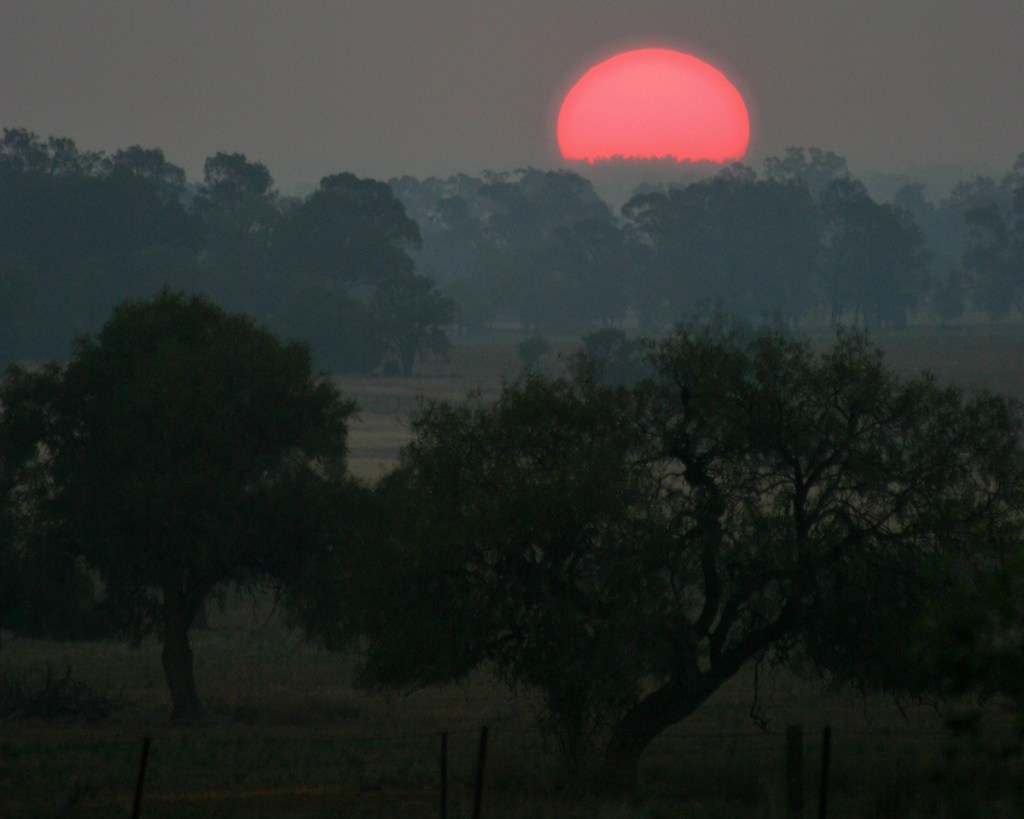
Eighteen years ago, I was doing contract communications work with a New South Wales (NSW) Government natural resource management agency. I recall a meeting about how to publicly communicate issues relating to ‘global warming’ or ‘climate change’, where the decision was made to use the phrase ‘a changing climate’ so conservative rural stakeholders wouldn’t be too alarmed. This was in the middle of what is now known as the Millennium Drought. My family had a farm at the time. We watched the land around us dry to a crisp and blow away on the wind, while hundreds of thousands of hectares in other parts of the State burned.
The playing down of what was then recognised as a major external threat to the future of rural and regional Australia, combined with political inaction, was a lost opportunity to rein in the impact of what is now widely recognised as a climate crisis.
Meaningless words
Language is central to effectively communicating important information—potentially changing behaviour. Whether words are concrete and well-defined or abstract and ambiguous makes a huge difference to the understanding of what we’re aiming to communicate. In the case of ‘a changing climate’, it inferred there was no urgency, and that any mitigating action was optional as humans probably had no influence over it anyway. As it turns out, that’s exactly how it was interpreted.
The year following the end of WWII, in 1946, George Orwell wrote about meaningless language in an essay for literary magazine, Horizon.
Our civilization is decadent and our language – so the argument runs – must inevitably share in the general collapse. He uses the word ‘fascism’ as an example: (it) has now no meaning except in so far as it signifies ‘something not desirable’.

As a young journalist, I was taught never to use jargon, avoid acronyms and always explain things as simply and comprehensively as possible. Today, it feels like navigating a theme park of smoke and mirrors. Even basic language is now loaded. Orwell suggests in his 1946 essay that the reason is politics and economics.
…it is clear that the decline of a language must ultimately have political and economic causes: it is not due simply to the bad influence of this or that individual writer.
In my creative work on social and landscape ecologies in rural and regional Australia, I’ve found an increasing number of overused, misunderstood, hijacked, and weaponised words in circulation, to the point they are now virtually useless.
Here are just a few: Carbon: carbon emissions, carbon footprint, carbon neutral, carbon-free, low carbon, carbon markets, carbon farming, carbon off-sets; Sustainable: sustainable futures, sustainable markets, sustainable farming; Eco: eco-friendly, eco-art, eco-tourism, eco-markets, ecosystem; Regenerative: regenerative farming, regenerative thinking, regenerative tourism; Nature/natural: nature tourism, nature conservancy, natural capital, natural assets. I know there are many more.

Weaponised words
A couple of years ago, I was talking with a friend about a project I was working on looking at the impact of fast-tracked renewable developments on Regional NSW in the push to achieve net zero with carbon-free energy (wind and solar). He said, “There’s no such thing as a life without carbon.” I rolled my eyes. We both knew what the other meant, but how many casually following the ‘carbon’ debate understand the definitions and nuances of the language?
Words feel like just another weapon in the climate wars. Our politicians certainly shape-shift their language to suit their cause—inflaming or deflecting. On 13 June 2024, Guardian Australia’s climate and environment editor, Adam Morton wrote wrote about Australian opposition leader Peter Dutton’s position on achieving net zero emissions and claims that the current targets are ‘economy destroying’, as the Australian tradition of hyperbolic political claims suggesting climate policy is a greater threat to the country than the climate crisis.
Poorly defined words
Earlier this month, I attended an event where a NSW Government representative spoke about natural capital and ecosystem services. The definition on their website says: Natural capital refers to the valuable resources and services provided by nature. Healthy natural assets provide benefits such as clean air and water, food production and climate control.
If you’ve got it, you may as well earn some money from it. Right? It all centres on the question, What does nature give us? It suggests we are not part of nature—that nature is just another commodity and our relationship with ‘it’ is purely transactional.
Definitions change over time. The definition of ‘nature’ has changed over the centuries going back to Greek times, from being about the character or qualities of an individual or entity to encompassing the physical or natural world…and back again. Nature is a social construct that changes with societal ideals at the time. Is nature all living things except humans, or a combination of human, non-human and more-than-human? It depends on what you believe and your understanding of the words in the definition.

Weasel words
Seventy-eight years ago, Orwell wrote there are many political words often used in a consciously dishonest way. That is, the person who uses them has his own private definition, but allows his hearer to think he means something quite different. The dated gender bias of Orwell’s writing aside, words relating to the natural world, our environment and the climate have been politicised and commodified to the point where they now fit Orwell’s definition of ‘meaningless’ words.
Reporting on the 2023 United Nations Climate Change Conference (COP28) in Dubai, Canadian publication the National Observer reported on deliberations over what language was needed to communicate a commitment to the reduction of fossil fuel reliance, and how weasel words were changing the intent. The high-ambition coalition and a group of the world’s largest cities are arguing for a “phaseout” of fossil fuels. But the conference host, along with other major oil and gas producers, prefers a “phasedown” of “unabated” fossil fuels.
Here we see politics and economics at play on the world stage. As the National Observer explains, the language of the final declaration would buy time for those with vested interests. Like the rewording of ‘climate change’ to ‘a changing climate’, those shaping the language have their own, private definitions and an intent that we’re not all privy to.
Truth-telling words
How do we communicate critical, world-altering, climate-related issues and the urgent need to change our behaviour, if we can’t agree on or have a common understanding of the language?
I’ve been writing professionally since I was a first-year student journalist with my university newspaper in 1988. I’ve spent the past three decades working in media and marketing communications across a range of industries and sectors in Regional NSW, including governments of all levels. I have used my fair share of weasel words in the name of public relations and marketing. It’s not something I’m proud of. I know what they look like, and I know why they’re used—it’s certainly not about telling the truth. We can’t continue to do this unless the aim is to make ourselves feel better about rolling over and condemning future generations to living on an increasingly uninhabitable planet.
This blog post has been written as part of the documentation of the SOIL+AiR creative future landscapes project.
 kvgoldsmithart.com