


On the first Saturday in March, I went for a drive across the farm at Narromine where I’ve been working with farmer and agroecologist, Bruce Maynard, on my SOIL+AiR Creative Future Landscapes project. Bruce wanted to show me an area he thought I might be interested in recording*.
Leaving the lanes that criss-cross Willydah, we turn into what looks like a house paddock, past a weathered, corrugated iron shearing shed and an empty farmhouse. After bumping through long grass, we stop while Bruce points out an area on the other side of the fence.
This regen area is one part of 15 percent of the property we fenced off 30 years ago. It’s an ephemeral wetland with a mix of Bimble Box, Yellow Box and River Red Gums. The River Reds are a relic population cut off from others. There’s understorey of Lignum and Nardoo.
Unfortunately, it will be returning to a production paddock as Passive Chemical Exposures (PCEs) have resulted in the gradual death of existing and recruiting vegetation. There’s no point in these areas of the farm being ‘regeneration’ areas anymore.
Regeneration and adaptation are both heavily influenced by the type, amount and frequency of disturbance events. Disturbance can be fire, grazing, storms, PCE etc. All ecosystems will gradually simplify to some degree if there are no ‘disturbance’ events. That means we need to judiciously use tools to encourage enough disturbance to enable a wider range of organisms to establish and be retained in the landscape. The tricky bit is that for any disturbance there are a wide range of consequences. The application of tools such as grazing must be more conservative than prior experience would indicate, as the inexorable changes driven by climate change will most likely lead to higher variations in landscape responses.
Our aim for having regeneration areas across 15 percent of the farm was to provide high value, recovering remnant areas in the landscape connected with other areas, providing pathways for animals of all kinds to survive amongst agriculture, rather than being excluded by agriculture. Areas of limited disturbance in highly disturbed landscapes are critical biological hotspots, and it was part of our long-term plan to not only provide that but show others that innovative agriculture that is truly profitable allows for the growth of natural systems—something that conventional agriculture continues to fail at.
The only constraint to achieving this has been Passive Chemical Exposures. Due to these events, we’ll be returning those deep regeneration areas back to production. Their ecological foundations are being killed and degraded on an increasing scale so there’s no point trying to create refuges in the landscape anymore.
— Bruce Maynard
Permeable boundaries
I sense Bruce’s profound despair in having to return this part of the farm into production. Boundaries are permeable. None of us exist within bubbles. Being a regenerative farm, doesn’t isolate you from the effects of climate change, nor does it protect you from the agricultural activities around you. Bruce has long protested the impacts of passive chemical exposures, sharing his concerns, and using his profile and platforms to advocate for change.
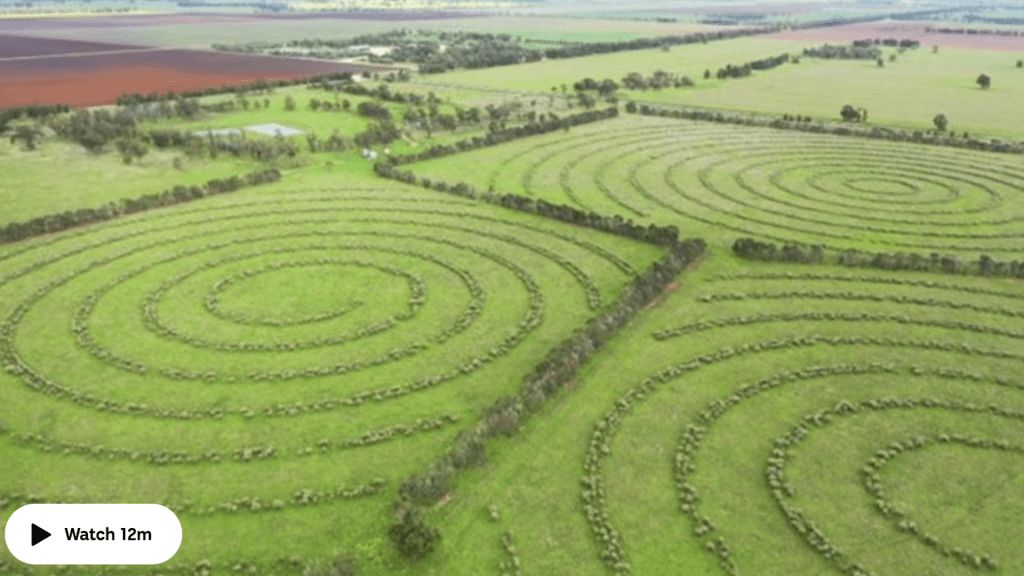
The consequences of our actions, be they chemical use or land management practices, are enduring. They set the conditions by which we not only operate today, but how and what future generations will have to do to adapt to increasingly unpredictable and degraded environments. Trees aside, we may not have human recruits populating our rural and regional communities if we don’t change now. Escalating climatic changes are upon us and we aren’t adapting quickly enough.
All the evidence indicates that those in the best position to adapt to a warming world will be those living in cooperative, considerate and resilient communities…’Preparing for a catostrophe,’ write Srvigne and Stevens, ‘…means weaving a web of connections around you. — Clive Hamilton & George Wilkenfield, Living Hot: Surviving and Thriving on Heating Planet, 2024
Between field trips to the Maynard’s farm, I walk the roads near home in the post-dawn hours of the morning, thinking about these issues. The roadsides here are populated with remnant dry sclerophyll forests (pictured below) of Western Grey Box, White Box, thickets of White Cypress Pine, the occasional Yellow Box, Buloak, Narrow-leaved Ironbark, Mugga Ironbark, small Kurrajongs, Wilga, and an understorey of Western Boobialla, various Wattles, Cassinia and Hopbush. It’s an isolated community, under threat. Amongst the grand, old giants towering above me, are smaller, narrow trunked juveniles, growing in the shade of parent trees. Below them, often nestled at the base, are toddlers or saplings of various species. It takes a village to raise a healthy forest.
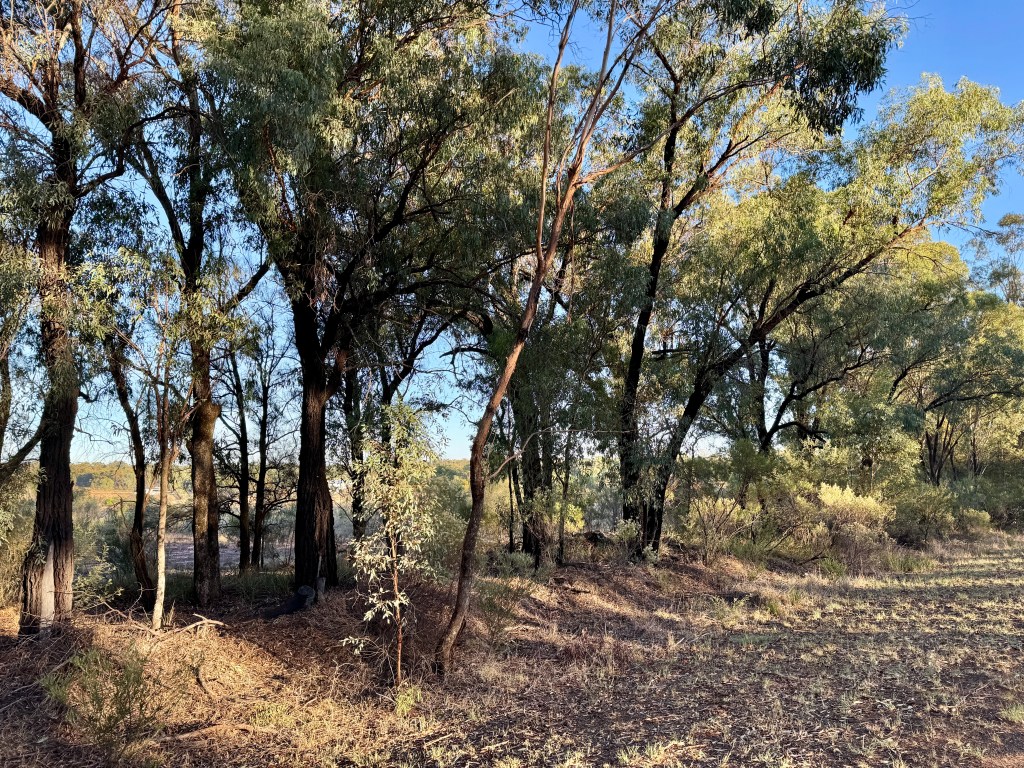


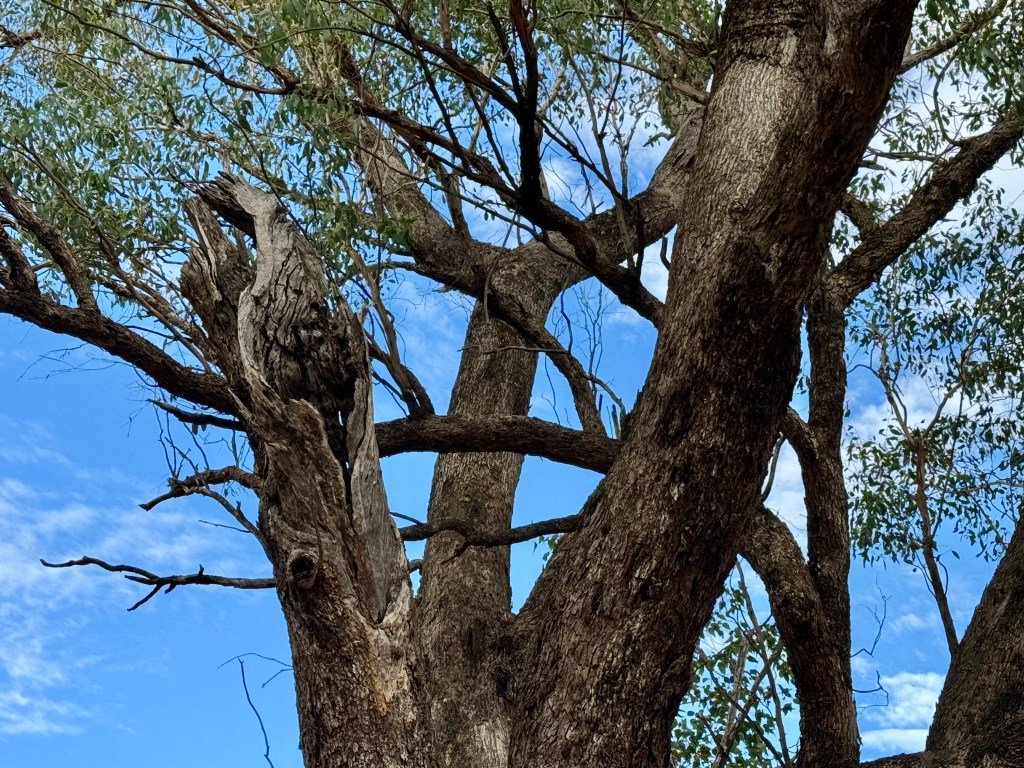
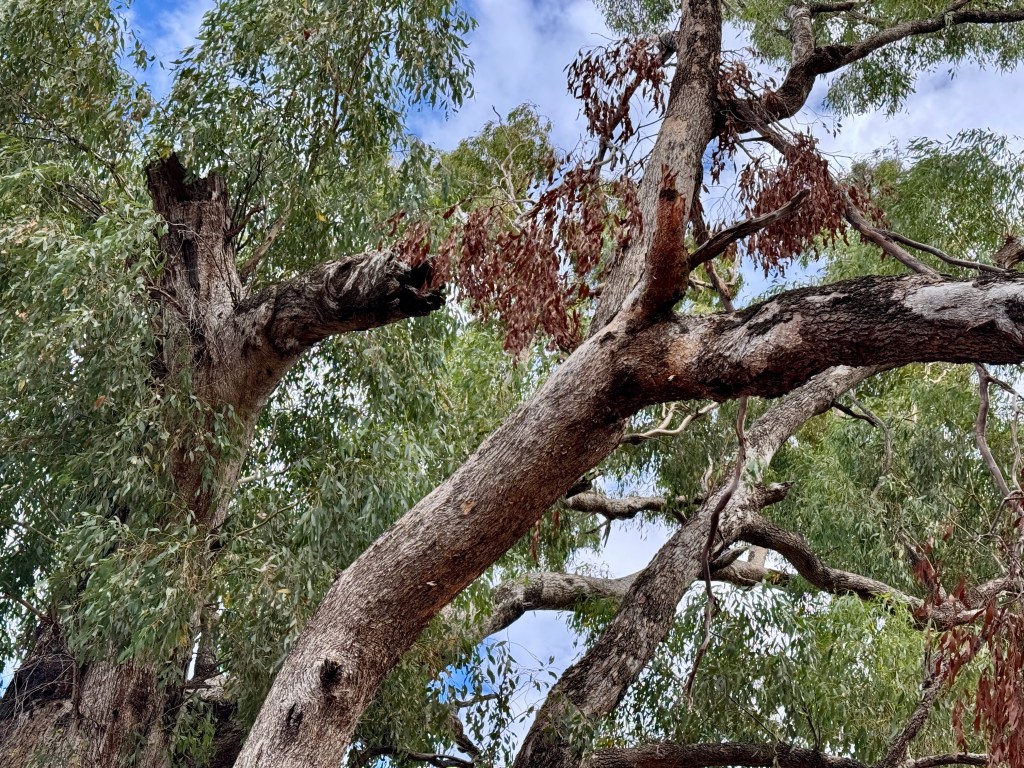
As lucky as I am to have this environment in my peri-urban neighbourhood on the doorstep of an ever-expanding inland regional city, the greatest threats to these remnant communities remain clearing, cropping, grazing, exotic species, and the application of fertiliser. Many blocks neighbouring me have been cleared over the years for hobby farming activities, some burned in the process, but thankfully no one is aerial spraying chemicals.


Cleared grazing land and road verges on the North-Western Plains of NSW, showing piles of bulldozed old Bimble Box trees (2019) and a ‘crop duster’ (2009).
Our world standing is a low bar
Broadacre croppers, particularly those with high value crops grown under high input systems, argue chemicals are critical to the success of modern farming. Instead of laying the success of primary production on vibrant, healthy soils, it’s claimed by some in the Australian industry that chemical use enables $31.6 billion of agricultural output annually. CEO of the organisation making this claim, CropLife Australia’s Matthew Cossey says, Economics aside, the fact is without pesticides, 78 per cent of fruit, 54 per cent of vegetables and 32 per cent of cereals currently produced for consumption would not exist.
Despite using less chemical and fertiliser than other developed countries, Australia’s peak science agency, CSIRO, reports that in 2017/18, Australian farmers used 50,000 tonnes of herbicides, insecticides, miticides, fungicides, antibiotics and anthelmintics per annum, spending around $3.1b on agrichemicals. Think about those figures alongside this statistic: 7.6 million tonnes of food is wasted each year in Australia across the food supply chain—a whopping 312 kilos per person. Food wasted in our homes equates to 2.5 million tonnes, costing us $2,000-$2,500 a year. And yet here we are complaining about the cost of groceries.
The productivity of Australian agriculture has slowed in the past 25 years. But, what if we produced only what we need to support a healthy and sustainable standard of living, and to maintain some existing export markets, rather than growing surpluses that push Australia’s fragile soils to the point of collapse. Food Innovation Australia reports more than 25 million hectares of land is wasted to grow food that is not eaten.
If we know that chemicals not only damage and kill a broad range of plant communities and destroy soil biota, are we prepared to adopt a less aggressive way of being, degrowth strategies, or at least more sustainable alternatives to constant growth at local, national, and global levels that might transition us to a gentler way of existing on this planet? Have we even got the will to create the conditions needed for our descendants to flourish in a more diverse and plentiful world? These are big, complex questions, and I don’t walk far enough most days to come up with viable answers.
A lifetime of change
I’m thinking about this as I watch Bruce’s son, Liam—close in age to my daughter, planting barley with no fertiliser, directly into pasture on Willydah. The seed is scratched into the surface of the red soils beneath dry, grazed pasture with discs about the size of dinner plates**, ready to receive the autumn rain we all hope is coming soon. My feet planted on hard ground beneath big blue skies and a hot autumn afternoon sun, I watch white and tea-stained smoke billowing on the horizon north and south beyond the farm’s boundaries. More conventional neighbouring farms are burning crop stubble in preparation for planting. They’re trying to reduce the likelihood of stubble-harbouring disease in yet to be sown winter crops, but will inevitably use chemicals to control weeds, pests and diseases during the growing season anyway.
I grew up on a large, conventional mixed enterprise, multi-generation family farm in Regional NSW, and for the first 35 years of my life I was determined to be a farmer despite my family telling me I couldn’t, wouldn’t, or shouldn’t because of my gender. I became a fifth-generation Australian farmer with my partner in the late 1990s. For 10 years, we grew cereal crops and legumes, and produced sheep for meat. Keen to diversify and do things that worked better with the environment in which we were farming, I studied Horticulture at TAFE so I could set up an on-farm tree nursery and native tree plantation for cut flowers and foliage. The Millenium Drought dominated most of the 10 years we farmed. It took a toll—more mentally than financially. Prior to being a farmer, I’d studied systems agriculture and journalism and became a rural reporter with ABC Radio for four years in the 1990s, where I covered droughts, floods, plagues and markets. After leaving the ABC, I established a marketing communications agency, specialising in rural and regional industries and issues management, providing services to the conservation farming movement, irrigators and cotton growers, beekeepers, Landcarers, natural resource management agencies, and regenerative farmers. After 25 years I couldn’t do it any more. I’ve experienced both sides of the farming fence and the grey area between. My extended family still farm, and I have friends who are farmers and work in the industry in other capacities.
I’ve unlearned, relearned, and continue to be intensely curious about the world, constantly considering different ways of thinking, being, and acting. I still believe in agriculture and our role as humans in nature with a capacity to do good—like managing those small disturbances that might facilitate biodiversity. This doesn’t change the fact that since my English, Irish and European farming ancestors arrived in this country on the First Fleet and the decades following, Australia has suffered the largest decline in biodiversity of any continent, including the highest rate of extinctions in the modern world. Much of this has occurred in my lifetime. This… This is what we’re leaving future generations.
Ignoring pleas to change
In 50 years, you might gaze out the window of your automated or partially automated electric vehicle as it passes through this region and wonder where all the people are? You’ll probably have to navigate a few potholes and broken edges on the road but you won’t be worrying about hitting kangaroos because there’s no permanent, accessible water left on farms here for roo populations to survive drought. A handful of human survivors might still inhabit places that were once small towns (cue, tumbleweeds). We didn’t make any serious attempt to adapt to what was coming and everything slowly disappeared over decades. What was left has been subjected to droughts, fires and floods of increasing frequency and intensity. We ignored the pleas to change.
Our regional city took in those rural refugees who didn’t move further east, putting increasing pressure on already scarce housing, health services, and welfare. Renewable energy generation and tech-based industries sustain the local economy because land became cheap and there’s plenty of sunshine to power the energy needs of these businesses.
The ancient Wambuul river that used to run through the centre of the city is a stagnant puddle most of the time. In between extreme weather events, a few scratch out a self-subsistence existence keeping animals or growing food crops on the floodplains outside the city, where centuries old River Red Gums once grew in fragmented communities. There’s nothing left to slow or hold back the flood waters now as clearing for urban development on the floodplain in last half century or more destroyed what little natural environment was left. A few innovators have tapped into groundwater aquifers to produce salt-tolerant food crops in climate-controlled greenhouses that stretch as far as the eye can see.
With governments of all persuasions pushing for increased productivity and growth, the day will soon come when the earth beneath our feet and all it supports can take no more. The elastic band will snap. I will have lived through the lead-up but I probably won’t be here when that happens. Some will say we had it coming. Others will maintain human ingenuity and technology will save the day. In the meantime, some of us hold on to just enough hope on good days that even if we can’t do a complete U-turn, we might at least buy our human and more-than-human communities time to adapt and lay more fertile foundations for our recruits.
It’s only human to engage in various forms of resistance—distraction, wishful thinking, technological rescue, fatalistic acceptance. But the sooner we pass through them and accept the reality of our situation, the safer we will be…our ability to choose a safer future is contracting the longer we delay. — Clive Hamilton & George Wilkenfield, Living Hot: Surviving and Thriving on Heating Planet, 2024
* I’ll be recording at this site over autumn and winter.
** No-Kill Cropping is a system of planting crops into the dry topsoil of pasture with minimal disturbance, as well as reducing the input of herbicides, pesticides and fertilisers. READ MORE
 kvgoldsmithart.com