

This month’s post is made up of two social media posts shared in July—both about listening. The first was written in response to World Listening Day on 18 July, and the second, a post written by UK-based regenerative culture practitioner, environmental activist, and artist Bridget McKenzie on Medium on 21 July.
What’s it mean to be a listener?
It’s World Listening Day. Instead of releasing new sounds, I’m dwelling on what it means to be a listener.
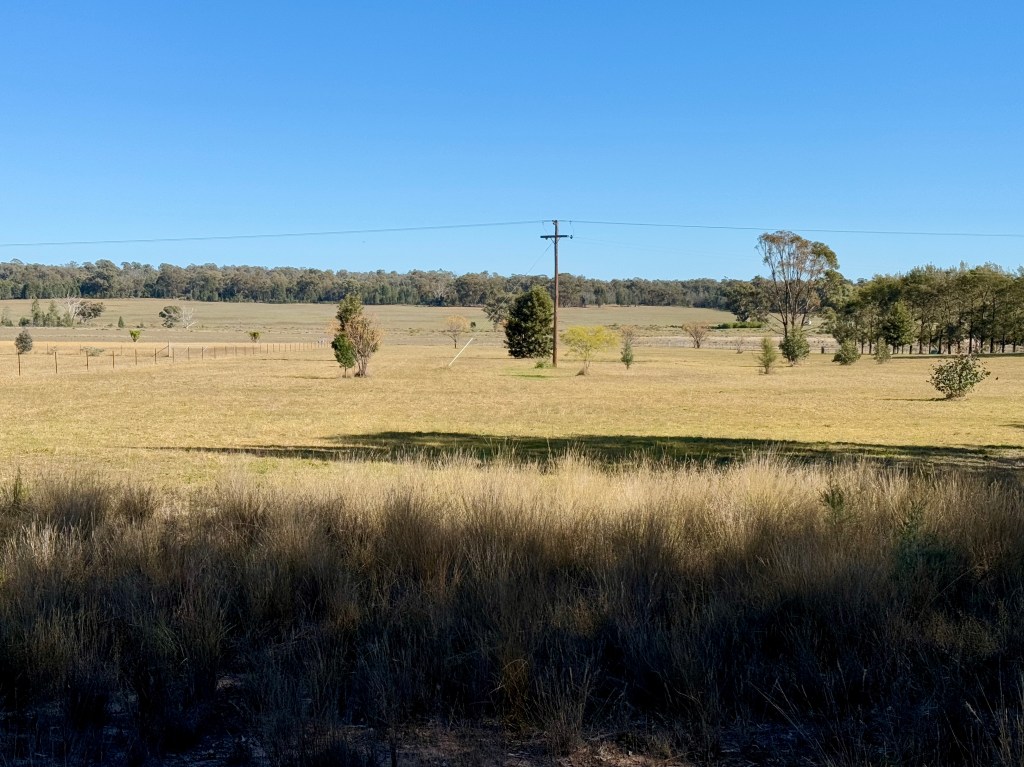
Behind the trees in the horizon of this photo is a 444ha solar development under construction. I live in a Renewable Energy Zone—the first in Australia. We live in the middle of what are the power stations of the future. Most of that power won’t even be used here but will keep the lights on in our ever-growing cities.
I regularly walk the road where I took this photo. Some of you have engaged with my writings and sound stories about those walks—full of birdsong, wind, the sound of my footsteps, occasional barking dogs, and the sound of traffic and planes in the distance. This week, the soundscape has been dominated by the ratcheting sound of construction. I live 2km from where this solar farm is being built and while I won’t see it from my place, I can hear it. Yes, I know that won’t last forever.
Last weekend (12/13 July), in the Power of Sound and the Handbook for Acoustic Ecology courses I facilitate (the former) and participate in (the latter), we talked about acoustic horizons and acoustic mapping. It’s had me wondering what noise do we find acceptable in our soundscapes? I’ve been looking at the impact of noise and anthropogenic disturbances on more-than-human worlds for a few years now, and the noise impact and disturbance of broadscale renewables is no better than land clearing for urban developments.
In the 2023 State Significant Development Assessment, the solar developers wrote: The project has been designed and refined to avoid and minimise biodiversity impacts, but would require clearing of 68.53 ha of native vegetation, including 68.06 ha of dry sclerophyll forest and 0.47 ha of grassy woodlands (an Endangered Ecological Community…require offset for 4.61 ha of native vegetation.
Sum total: less trees and woodlands, less birdsong, insects, and a vastly altered soundscape. I’m not anti-renewables, but we’re doing this all wrong.
What’s the point of listening?

This is a question that came to me after reading Bridge McKenzie’s blog post, The Feeling Bodies of a River on Medium, that raises questions of our separation from other species and more-than-human entities, and whether we need to be anthropocentric to communicate the need to care for those things that are commonly thought to be non-human? As Bridget rightly says: The Environment is not a topic outside of human issues…it is MORE THAN.
As a creative whose sound-based practice is centred on the act of listening, I often ask myself why I encounter either intense interest in the idea of listening or indifference. There’s little middle ground. I often say indifference is the enemy of art, but it could apply to our connection and entanglement with more-than-human worlds too.
For me, listening quietens my dominance over the environment I’m part of. It provides space for others. We often talk about protecting/ advocating/ regulating on behalf of “nature” or the “environment” but we rarely, if ever, listen or provide a way to give non-human entities a voice. Perhaps even thinking like that is anthropocentric, but as Bridget writes in her blog: Humans are not supreme above all other forms of life, but their distinctive powers, technologies and populousness mean that we are crucial actors for planetary health.
***
I’m thinking about the questions raised in both posts, and others, as I spend time in the field working on new recordings for a solo exhibition in 2026. The focus of this work is the Endangered Ecological Community (EEC) of the South East Corner Bioregion on the South Coast of NSW. I lack an intimate knowledge and comfortable understanding of this part of the country despite having been a semi-regular visitor to the area for the past 30 years. I’ll need to be listening deeply and attentively to ensure I have what I need to proceed with any field recordings. The trees, soils and wider ecosystem of the region I hope to work must be willing to offer up their voices to me before I might share them.

 kvgoldsmithart.com