
EXHIBITIONS HOME PAGE · SONGS OF SOWING & REAPING WORKS (to come) · PROJECT BACKGROUND
Future Kin collection
The stories, values, culture and knowledge passed on to future kin are the threads that weave through the decades and centuries, tying regional communities to the land that shapes them, and creating the foundations of a future. Each community on the Western Plains has its own identity, history, challenges, and hopes for the future. How that is realised will come from within. These are just a few of the stories of those working to create that future.
Questions put to each person whose responses you can listen to below included (noting not all questions were answered):
- What knowledge do you want the next generation to have? (What do you want to share with the next generation or what do you want to know from your Elders?)
- What actions do you think need to happen to ensure we’re good ancestors? (Big and small, local and global)
- How hopeful are you about the future?
Trangie, Wongaibon Country: the future of the community
A selection of portraits are showing at the Wungunja Cultural Centre with more in the Future Kin series showing at the Western Plains Cultural Centre in Dubbo from 17 October.
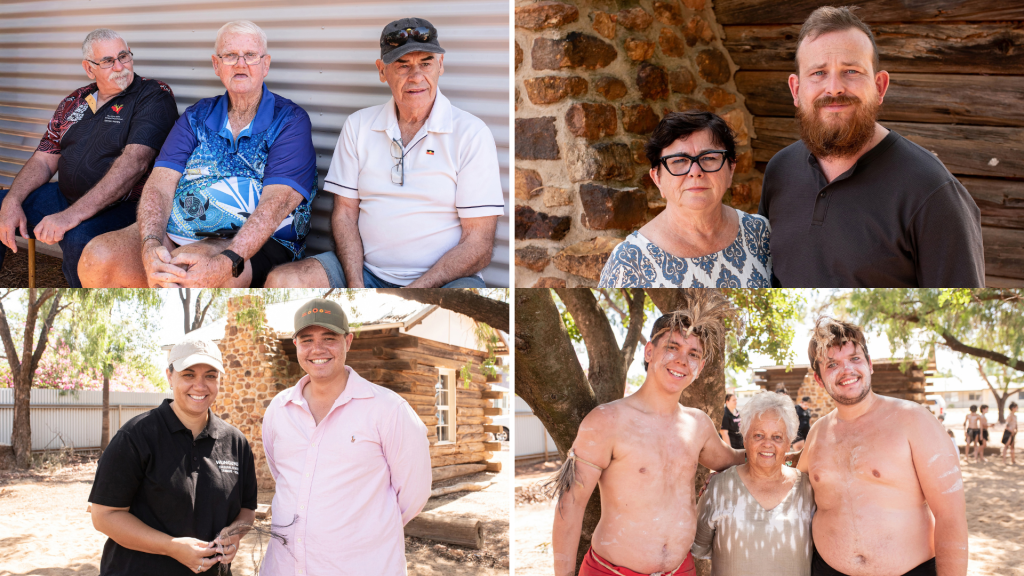
Biggest thing we can do is build ourselves back up as a community, where stories and knowledge are passed down with each other. – Rowan James
Uncle Tony Lees
Uncle Trevor Lees
Minnie James
Rowan James
Pat Skinner
Jess Skinner
Ashton O’Neill
Aunty Ruth Carney
Yaama, I’m UNCLE TONY (LEES). I think we’re trying to be good ancestors. We need to get together more. That’s one of the things that we’re not very good at. Passing knowledge on this has been exceptionally easy to do. But we need to get together more often to be better ancestors.
My name is UNCLE TREVOR LEES. It’s so wonderful to see the youth take part in ahh the festivities of today. It’s all about them in the future, obviously. We can tell, ahh community what we know about, uh, our past peoples. And the importance of, ahh, our people looking after the land…very important, and everyone should think about that — not just know it, think about it, because it’s up to everyone to, ahh, take care of the land.
And it’s a great…It’s great to see these, ahh, kids dancing like they do, and, ahh, a lot of credit go to the people that teach them how to do it, and that sort of thing. And we’re very fortunate that we’ve got our own troop…and there should be more of it.
My name is MINNIE JAMES. I think they need to know a lot more about the Aboriginal culture, the Indigenous culture, because when we were kids, we didn’t get that. We didn’t get a lot of that knowledge at all…we weren’t taught anything At school; we weren’t taught anything from family because it wasn’t done…it just wasn’t done.
Even now, a lot of the kids don’t know things, like, you know, how they were taken away…like, the stolen generation. As a person born in the 1960s, I could have been one of those people. I don’t think the kids realise what, you know, our generation and my dad’s generation had to put up with.
My name is ah, ROWAN JAMES. We need to regain what knowledge was lost and rebuild, and pass it down as far as we can, so it continues on. It’s all going to be important… knowledge of dance, our song lines, where we are, who we are as a people. The things that have happened to our people and what we need to look out so it doesn’t happen again.
Biggest thing we can do is build ourselves back up as a community, where stories and knowledge are passed down with each other. And we may have to go outside of our region to find more information about things that we don’t know, that we’ve lost.
Time will tell. Unfortunately, we don’t know where we are at this time in the world, but I am hopeful that it will be a good future — one where everyone is accepted and everyone gets along.
PAT SKINNER’s my name. Pretty much the custodian of knowledge with items being passed on from others. So how to make a clapstick, how to make a coolamon. equipment. Those one-on-one tool sets that are really important to cultural revitalisation that we’re currently undertaking here in Trangie.
It’s something that can be taken away from you within the blink of an eye, but it also comes along with stories, songlines, and with that knowledge, also comes ancestral connection. So, for this area, we’ve got certain tools that are completely different to Wanaaring, down at Baakinji land, or we’ve got different stories to tell in regards what a coolman means to us…and it’s only 32 kilometres west, and that’s Narromine. They have a different complete connection to those tools. So, it’s really important for us to make sure that we know what it is here, locally.
I think there’s a lot of understanding that First Nations have always passed down ancestral knowledge to verbal, face to face, times. But however, we need to start utilising technology to record them, archive them in a safe place. What our organisations from the LALC to Thriv3 undertaking will also help that. So, yeah, it’d be good to utilise those technologies, yeah.
JESS SKINNER. Whether it’s our local Aboriginal knowledge, or whether it’s cultural knowledge, or even just through the education system. So I think all knowledge is really important for our young kids. Particularly for here, when we’re talking about our Wongaibon kids, or our kids on Country here; we say they’re born with a white shoe and a black shoe, and they need to walk in both worlds. So, they need to be able to get their good education, but then here, our responsibility culturally is to make sure that they’re also tied to this side of it as well. And, um, that is taken care of Country, that is, um, learning our stories, our songs, our dance…and that disconnect hasn’t always been there.
So, it’s really important when we have our kids here, and we’re revitalising that sharing, that they’re a part of that journey as well.
This dance group has been around for a really long time, actually. Pat (Skinner) was one of the first kids in year six when he joined this, when we established it. So, you know, I’m so proud of those kids because they’ve gone on to do amazing things, whether it’s in government, whether it’s in health, law, teaching, become mothers and fathers, and raising really culturally strong kids as well.
We’re connecting dots that have been separated and, ah, missing for a little while, and so that work’s really important…and once we get all those dots connected, it’s only going to be strong. But, um, the beautiful thing is here and Trangie, is that we lead with reconciliation too. It’s not a hidden sort of learning, it incorporates everybody as well.
My name’s ASHTON (O’NEILL). I think it’s important to know the traditions that we used to once have, like those that have been lost throughout the generations, and actually revive that knowledge, and also just dance, like, the stories that we showcase aren’t just to dance there. They have meaning behind it, and that’s really important to understand for the next generation.
I think it’s important to go out and understand not only my culture, but other cultures, and then bring that knowledge back to Trangie. We have great facilities here, like the LALC and the Cultural Centre, but also we have other parties like Thriv3 that are really helping bring that culture back to the community.
My name is RUTH CARNEY. I’m known in the community as Aunty Ruth Carney, and I’m a proud Wiradjuri Elder, and my tribe is the Warramunga tribe. If we can nurture ourselves to be respectful and be proud of our heritage and our culture, that we care and share, each and every day, that we have in that opportunity to do.
I’d love to think that the younger generations will take great opportunities that are handed out, and grab them with both hands. Because being an Elder, I haven’t been as fortunate as what the younger ones got today. So, in future years, I’d love to think that if what happens to me will sometimes ring in their ears that how lucky they are, if they can just heed the warning and take every opportunity that comes their way.
‘Willydah’, Narromine: the future of farming
Note: The Maynard family portraits are showing only at the Western Plains Cultural Centre, Dubbo from 17 October.
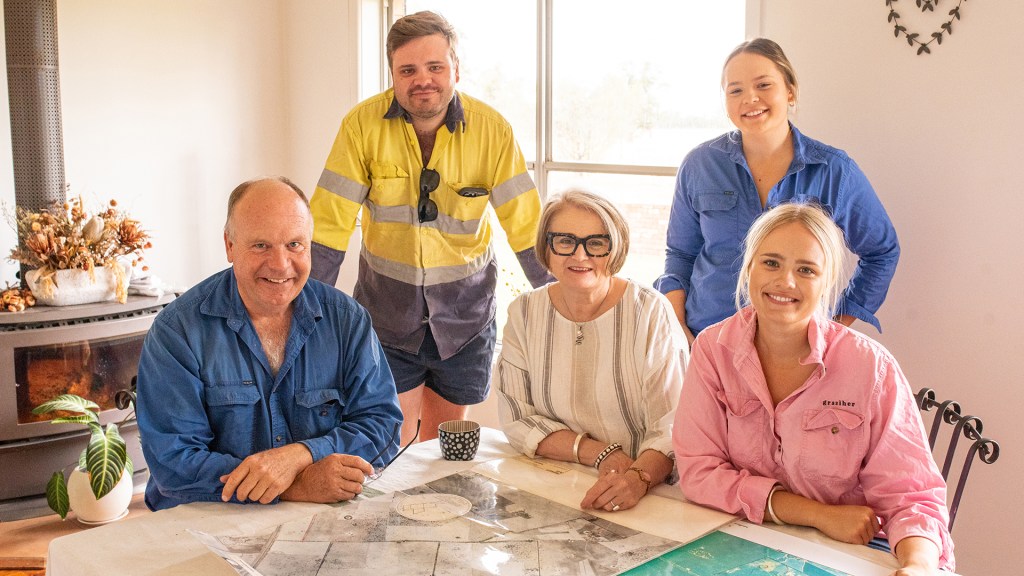
I’d like the next generation to know that it’s not a choice between our human needs and natural landscapes. We can do both and creatively grow both of those. – Bruce Maynard
Bruce Maynard
Roz Maynard
Liam Maynard
Ella Maynard
Hannah Maynard
My name is BRUCE MAYNARD, and I live at Willidah, Narromine, which is our family property, about halfway between Narromine and Trangie.
I’d like the next generation to know that it’s not a choice between our human needs and natural landscapes. We can do both and creatively grow both of those.
I think we need to reflect on the longer term and look forward. Being an ancestor is actually then determining to look forward to what we would like to be plentiful and desirable in the future [sic].
ROZ MAYNARD. I live at Willydah, Narromine, and my main thing to do here is keeping the house going and the farm, and supporting the children and Bruce, mainly.
My children have grown up with all the practices that Bruce and I have applied, and I just hope that they can carry them on, naturally, and hopefully that they’ll be happy doing it and enjoy life…so they can keep that going through, passing that on to generations [sic].
I think that, um, if we can show them how to get back to nature, we can pass that on to them, and, um, hopefully they will learn by that.
I just hope that my kids can pass on just to be happy and enjoy life, and get it all back to nature, and… and be in the community and doing that as well.
I’m LIAM MAYNARD. I’m a farmer from Narromine in Central West, New South Wales.
If you’ve got a passion for what you want to do or what you’re trying to achieve, go for it. There’s no reason not to. You just, you need to have that crack, you need to have a go, get into the industry, get into any industry of any kind, and yeah, world’s your oyster.
I’ve always loved farming. So I grew up on a family farming operation, and, yeah, it just, it runs deep, it really does. Obviously, we’re a little bit non-conventional when, so to speak, when it comes to the agricultural sense that everyone would be picturing. But yeah, absolutely love the lifestyle, love the ability to just get out, do something different every day. It’s just, yeah, it’s life.
Obviously we need to open up a sector or an industry that allows newcomers to be able to jump in and have a go in the way they want to. And currently there’s limited pathways for that to happen. And I believe that’s the biggest change I need to see in my generation to allow the next to come in.
I’m ELLA MAYNARD. I’m a new graduate occupational therapist, and moving to Darwin, for a bit more of a remote job.
I think there’s a lot of happiness in the landscape, and what the farm can offer you, and, what the rural places can offer you, and there’s lots of jobs, there’s lots of opportunities that people might often overlook, compared to the metro areas.
I think that all starts with education, so, training up more people in the health industry, and, trying to encourage rural placements and all that sort of stuff, to get people to stay out in these areas…And yeah, passing that on, so we develop more of a settlement back in the bush. I think it’s always sort of migrated to the city.
I think living in a rural area does give you a lot of opportunity that you wouldn’t have otherwise. I think it’s really important to remember that you can do big things in the bush, and it’s not a limiting factor, it’s an opportunity.
My name is HANNAH, and I’m a farmer and also a current student studying agriculture.
As the next generation of farmers, I think we need to know how our land is working for us and what we need to do to help it keep working for us.
You don’t have to do things conventionally for it to work. Anything can be done in different ways. You just have to be willing to try.
I think, as the next generation, I definitely will probably be going in the different directions, because seeing it over my lifetime, you can do that. So why not?
Anyone can do anything in farming or agriculture; you don’t have to be from the country, you don’t have to be…you can be from anywhere, and you can try your hand in it. There’s so many opportunities around here, and you don’t, once again, have to do it conventionally if you don’t want to.
EXHIBITIONS HOME PAGE · SONGS OF SOWING & REAPING WORKS (to come) · PROJECT BACKGROUND

