

For decades I’ve heard artists say their art does the talking for them. As someone who likes to write, putting together an artist or work statement has never a problem, but I know artists who really struggle to explain WHY they do what they do.
Many will describe the subject matter and the mediums used to create the work, but often their why isn’t clear. It’s impersonal. Some rely on the subterfuge of ‘art speak’, big words or abstract concepts to distract you from the fact they don’t really know the answer.
I came to art through a back door, and for many years I wanted to understand not only how the art world worked and how to be part of the ‘club’, I wanted to be able to talk meaningfully about the creative interpretation of and responses to abstract ideas and philosophical questions, while also knowing and understanding the history of what had gone before me. Inevitably, a curator or more ‘knowledgeable’ person would ask who influenced my work and I felt the pressure to have a well researched and crafted response, even if I wasn’t being completely truthful. I remember, all too painfully, a public artist talk where I hadn’t prepared for that question.
The words we should all have within us
Early in my practice, I was told by someone I respected that I wouldn’t be taken seriously because I didn’t have a piece of paper to say I had an arts qualification, and that exhibiting my work alongside those who did was an insult to those artists. That was 20 years ago. Those remarks burned deep inside me for a long time. I think about this in light of yet another university in Australia closing the doors on its art faculty and creative courses, and the sector angst about where will the creatives of the future learn their craft. Ironically, six years later I was asked by that same person to teach art marketing in the now decimated TAFE arts faculty. It’s amazing how quickly the elitist snobbery disappears when you realise there isn’t anyone else available.
The past two months have underscored just how important the words are around a creative practice, but I’m not talking about words learned in art school. I’ve taught communications and marketing to enough art school graduates over the years to know that writing in a heart-felt way about your work doesn’t feature highly in these courses. These are words we should all have within us—the words that give us the burning drive to do what we do as creatives. Something bigger than us.
The role of artists today
I believe art has the power to explore complex issues and difficult conversations about the state of the environment and the future of humanity. I believe the arts can show us just what is possible. I believe artists have the capacity to hold safe spaces to have these conversations.
I recently listened to word master and playwright, Joanna Murray-Smith give the last Stephen Murray-Smith Memorial Lecture at the State Library of Victoria, where she spoke of her early years as a playwright.
As I’ve said many times before, you only need to be 51% ego to 49% vulnerability to survive as an artist…You need doubt, you need fear, you need chaos, you need mystery—all the things that normal people try to avoid or suppress is your gold. But bit by bit, you learn all the things you have to say, and that the job is to reach into the world and to be as honest and complex and unresolved in questioning, and as flawed on the page as you are off it. Because a writer who knows too much won’t write with wonder, or poetry, or truth. This is the freedom of the professional artist in any form. This is a freedom that we come to. It’s not exactly self-belief because that’s not only illusive but also a mixed blessing. It is an acceptance. Uncertainty and refusal to give up—the two are held together in an infuriating but compelling chorus, I’m not sure I’m any good but I found my own way of seeing the world.
The nature of writing and presenting plays is a collaborative process. As a creative who has worked my way around, through, up and down the ladder of creative development—and who initially struggled to define my why, after 20 years of collaborating with other creatives, I’m convinced collaborations are far more compelling long-term than any solo aspirations.
At a recent regional NSW arts forum and a roundtable session on sustainability in the sector that I was part of, the role of the individual as artist and artist ego was discussed as we questioned provocations put to us. Yet our table of seven was the only group in the room of more than 80 people who even questioned the definition of the word ‘sustainable’.
sustainable (1976 OED definition): Designating forms of human activity (esp. of an economic nature) in which environmental degradation is minimized, esp. by avoiding the long-term depletion of natural resources; of or relating to activity of this type. Also: designating a natural resource which is exploited in such a way as to avoid its long-term depletion.
Do we only want to maintain the status quo, or do we want something far more abundant and life-giving for us all—a more connected way of thinking, doing and being? Arts bureaucrats are now using sustainable in lieu of viable for the financial section of grant applications—with no budget line required for determining the real ‘sustainability’ of projects, setting up the ideal conditions to boil the frog…if it isn’t already cooked.
I often grapple with how ‘green’ my digital media practice is but I’ve never been questioned about it by anyone. Even as a writer, I use technology made from mined rare earths and I use re/search capabilities fuelled and maintained by finite resources. As an ecological artist, is the sharing of sounds and macro images of ‘hidden’ life with others in the hope more people will connect more deeply with the natural world enough for me to justify continuing to use this technology in future? I don’t know.
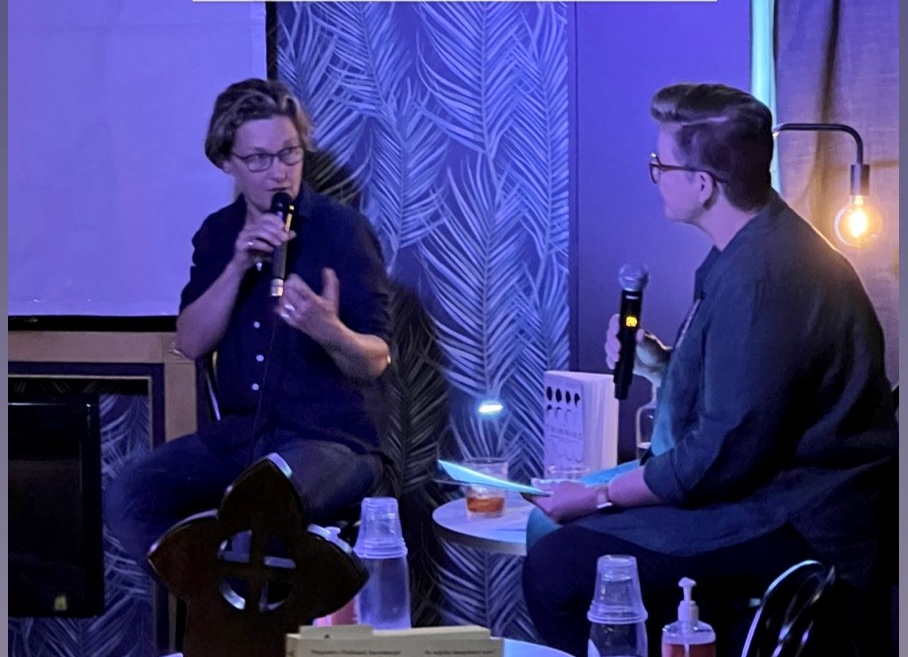
If we don’t get a grip on how we need to adapt to rapid change across our increasingly volatile planet, and come together to find creative ways to address the systemic change required to address the very real existential threats we face, it won’t be long before we’re operating in the dystopian near-future without the comfortable safety nets we now take for granted—a period in which many Australian writers are now setting their not-so-fictional stories. Having recently interviewed Inga Simpson for an author talk about her latest novel, The Thinning, it’s evident the near-future is creeping up on us all too quickly. It even took her by surprise.
There is still so much beauty. And love. But that’s why hope is so scary, because there is more yet that we could lose. – The Thinning. 2024.

I recently facilitated two panel discussions between artists and regional communities for the Regional Futures: An Entangled Existence exhibition public program, designed to create opportunity and safe places for conversations about the issues influencing the future of Regional NSW. One was face-to-face in the gallery at the opening on 26 October with locals from the NSW South Coast community of Moruya, the other was online on 13 November, with an audience made up largely of regionally based creatives of different artforms.
Blayney-based Regional Futures artist, Laura Baker said in the online discussion:
It starts with us. It’s not acceptable any more to go, ‘This is for the Government to solve, or this is for the organisations with the big money to fix.’ What I’ve been really encouraged by through this Regional Futures experience and conversations around it is that it’s starting small, it’s grassroots, it’s individuals making a change to their daily lives and putting in their own personal effort and I think that’s what we all need to do now.
Echoing this in the chat during the online panel discussion, fellow Regional Futures artist, Wallabadah-based Gamilaraay Yinaar woman, Tania Hartigan wrote:
…start small, look at our own practices and collaborate. It is up to all individuals…have conversations with everyone around you. Collaborating keeps us inspired…we are social beings.
For all the hope we try to nurture, there’s a feeling of despondency about just how much agency we have as artists or how close we are to the table to really influence change. As the arts continue to be devalued or undervalued. This was raised in the Regional Futures online discussion by international multi-disciplinary artist, Anna Glynn, and reflected in comments about the discussion later on social media. Regionally based artistic director and music theatre creator, Dianna Nixon, said in response on LinkedIn.
I’m a teeny bit pessimistic about the power of the arts to affect real change at the moment, but deep down I know it has a part to play. I won’t give up trying.
Governments are not committed to the arts despite all the publicly lauded policies unveiled over the past year. Artists are leaving the sector simply unable to support themselves or the creation of new work. For some, even believing in their why is not enough to keep going.
How might we play a role in bringing about change?
Released this year in the journal, Ecology and Society, was a multi-authored paper titled 9 Dimensions for evaluating how art and creative practice stimulate societal transformations. The tool created from the research is designed to respond to a need shared by creatives, researchers, policy makers, and funders to reflect and speak meaningfully about the link between creative practices and sustainability transformations. In the conclusion it stated… co-creative approaches almost always seem to offer many benefits over less co-creative approaches, allowing participants to develop co-ownership, share ideas, develop relationships, and develop skills.
Knowing (and believing in) your why is a starting point and talking about it is a must, but both are not enough on their own. While we must keep having these conversations—bringing people together online and face-to-face for in-depth sector dissections and in-place community gatherings, we ultimately need to bring about actions each of us can play a part in and take responsibility for.
In summarising the nine dimensions for talking about creative practice and change (or my take—creating a practice for change…), we can change meanings through embodying, learning and imagining; change connections through caring, organising and inspiring; and change power through co-creating, empowering and subverting. Over this past two months, I feel I’ve touched on all of these, but there’s still much more to do.
This blog post has been written as part of the documentation, wider research and thinking for the SOIL+AiR creative future landscapes project.
Photos from October/November: 1. My Humi Haptic Hands sounds sculpture (co-designed with Brian McNamara) and Humi soundscape composition in Regional Futures: An Entangled Existence at the Basil Sellers Exhibition Centre, Moruya (26 October – 23 November 2024). 2. The in-gallery panel discussion with community at the Bas on 26 October. 3. The artists and friends on a cultural walk at Bingi Point on the South Coast with Yuin Elder, Aunty Trisha Ellis on 26 October. 4. Walking at South Durras with friends Anna Glynn and Peter Dalmazzo. 5. Camilla Ward listening to Yarngun, a soundscape composition blending the sounds of a River Red Gum and voice of proud Wiradjuri woman, Kerry Ann Stanley for the First Families exhibition at the Maliyan Cultural Centre. 6. Listening to Kerry Ann Stanley talk about the importance of family history for identity and belonging in an audio story I recorded for First Families. 7. Jane Richens and me at the Regional Arts NSW Work of Art Showcase and Forum in Orange on 14 November. 8. Jodie Munday, Sandra Kozleuchar, Camilla Ward and me at Work of Art in Orange. 9. With Inga Simpson at her author talk about The Thinning in Dubbo on 16 November.
FURTHER READING
ClimateCultures essay: Exploring Regional Futures, 21 October 2024
 kvgoldsmithart.com
One Reply to “”
Comments are closed.